- Reimagined (formerly Anti-Racism Daily)
- Posts
- How MLK Day became a holiday.
How MLK Day became a holiday.
The fight–and implications–of the commemoration of Dr. King's life and legacy, plus works worth exploring this week.

Nicole Cardoza
January 19, 2026

Forwarded this newsletter? Subscribe here.
When I was in sixth grade I was attacked by a dog. It latched onto my hand and, when I pulled away, its teeth sliced a three-inch gash across my left palm. Worried about infection, the doctors opted against stitches so it could heal on its own, and I spent the next day – Martin Luther King Day – in repose, my hand bandaged like a mitten, weary from a night in the ER and whatever drugs they gave me for relief.
For whatever reason–boredom, grief, curiosity–I spent the day learning about Dr. King. Not what I had been told about in school, but anything I could find online using our (relatively) new home computer. I remember being surprised that he published books, that he talked about things like war and socialism, and that there were pictures of him in color, not just black and white. His life and legacy was my entry point to a more comprehensive view of the civil rights movement, which has influenced my life ever since.
Today’s holiday is not without its criticism. Martin Luther King Day helped foster a whitewashed, distilled view of Dr King’s legacy, one that depicts him as someone that only advocated for unity and peace. It also buries how, during his lifetime, many viewed him as an extremist and a threat to democracy. Neither narrative speaks to his groundbreaking views, his lasting commitment to racial equity, and deep commitment to his family and community. It's our responsibility to honor his legacy beyond what's been deemed "appropriate" by education and media.
But without this commemoration, I wonder whether I would’ve learned about Dr. King at all. Would sixth graders today have the same experience, knowing how swiftly our history is being erased in curriculum and textbooks? It was a momentous feat to make today possible, giving us all space to not just honor Dr. King’s legacy but interrogate it, and interrogate ourselves and our relationship to justice.
This day is a perfect entry for my newsletter highlighting this year’s Black History Month theme: 100 years of commemorations. For today’s issue, I’m adopting the format of the 28 Days of Black History month series so you can get a sense for the cadence in February. If you want to read more once it starts February 1, subscribe here.
Readers like you make this newsletter possible.Consider making a one-time or monthly donation on our website, PayPal or Venmo (@reimaginednews) to help sustain this work. You can always manage your subscription here.
Take care,
Nicole
ps – looking for the audio version of this newsletter? Click to read the web version, and you’ll find the audio recording at the top of the page. This is a service provided by Beehiiv, our email publishing platform, and AI-generated.

Dr. King, left, and Coretta Scott King, right, marching during the Selma to Montgomery marches in Alabama in 1965.
On April 8, 1968, just four days after Dr. King was shot to death on a Memphis motel balcony, Michigan Congressman John Conyers proposed establishing a federal holiday honoring the civil rights leader to Congress. The timing seemed right. The nation was engulfed in grief, and King's funeral drew millions of mourners. But despite the public outcry to Dr. King’s death, Conyers' bill went nowhere.
At this time, Dr. King was still considered a controversial figure. Polls in the late 1960s showed that most white Americans distrusted King or considered him too radical. His opposition to the Vietnam War had alienated many moderates, and his Poor People's Campaign was believed to threatened economic interests. "People say that King is moving too fast after 1965," said Lerone Martin, director of the Martin Luther King Jr. Research and Education Institute at Stanford University. After the Voting Rights Act passed, many Americans felt Dr. King should have stopped pushing for more.
For the next eleven years, Conyers and the Congressional Black Caucus reintroduced the legislation annually. It never came up for a vote. Opponents cited various reasons: federal holidays shouldn't honor private citizens, the cost to the government would be too high, or King didn't deserve such recognition. Some made more sinister allegations, suggesting King had communist ties or personal shortcomings that made him ineligible for such honor.
By 1979, on the 50th anniversary of King's birth, momentum had finally built sufficiently to force a House vote. Coretta Scott King had spent years lobbying Congress. The King Center organized rallies and collected 300,000 petition signatures. President Jimmy Carter publicly supported the measure. When the vote came, supporters felt confident.
They needed a two-thirds majority. The final count was 252 in favor, 133 against—five votes short. Missouri Congressman Gene Taylor led the opposition, emphasizing cost and tradition. The defeat was devastating for supporters who had worked for over a decade to reach this moment.
But Coretta Scott King refused to give up. She intensified her lobbying efforts, speaking at churches, universities, and civic organizations across the country. She built coalitions with labor unions, religious groups, and civil rights organizations. And she found an unlikely but powerful ally in Motown.
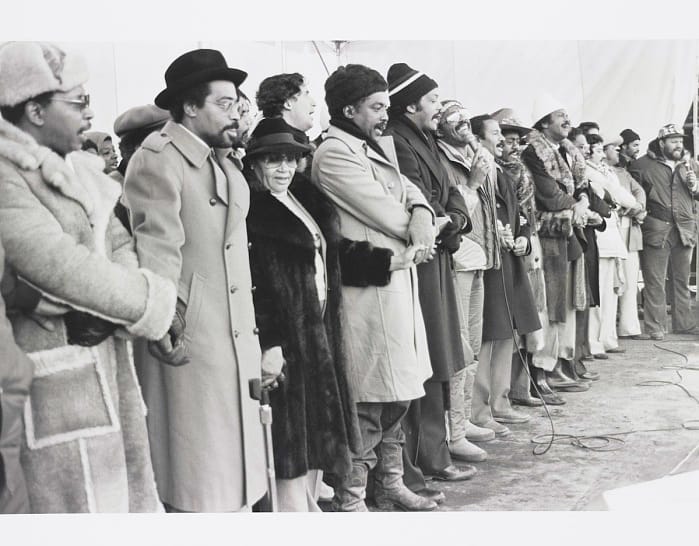
Stevie Wonder singing “Happy Birthday Dr. Martin Luther King to you” at rally on the National Mall in protest for a MLK Jr. National Holiday. Photo Source: NMAAHC, Smithsonian
In 1980, Stevie Wonder released "Happy Birthday" on his album Hotter Than July. The song was explicitly written to promote the King holiday: "I just never understood / How a man who died for good / Could not have a day that would / Be set aside for his recognition." The song became the track for the movement, and Wonder joined Coretta Scott King at rallies across the nation. At the close of a four-month tour in 1981, he organized the "Rally for Peace Press Conference," a massive benefit concert on the National Mall, drawing attention back to the site where King delivered his "I Have a Dream" speech. Wonder's involvement brought younger Americans into the movement and kept the issue in the public eye.
 | Rupture and RepairTuesday, February 10 | 3-5pm EST Learn how to navigate moments of tension and conflict as they arise in professional settings. Participants will learn practical, real-time strategies for de-escalating situations, intervening effectively, and rebuilding trust after moments of rupture. We’ll develop a personalized toolkit for addressing workplace tensions while maintaining cultural awareness and psychological safety. |
 | Conflict Evolution 101Wednesday, March 11 | 3-5pm EST Learn how to navigate moments of tension and conflict as they arise in professional settings. Participants will learn practical, real-time strategies for de-escalating situations, intervening effectively, and rebuilding trust after moments of rupture. Through hands-on practice and scenario work, we’ll develop a personalized toolkit for addressing workplace tensions while maintaining cultural awareness and psychological safety. |
By 1983, the King Center had collected 6 million signatures on petitions supporting the holiday. When the bill returned to the House floor that year, the political calculus had shifted dramatically. Democrats like Speaker Tip O'Neill and Jim Wright joined Republicans Jack Kemp and Newt Gingrich in supporting the measure. With a 338 to 90 vote, the bill was singed by President Ronald Reagan in November 2, 1983. The holiday was first celebrated in 1986.
Federal recognition was only the first battle. Getting all 50 states to observe the holiday took another 17 years. Arizona became the most contentious holdout. When Governor Evan Mecham rescinded his predecessor's executive order recognizing the holiday in 1987, it sparked a massive protest movement.

Paul Tagliabue, right, when the NFL moved Super Bowl XXVII from Tempe, Arizona, to Pasadena, California, after Arizona voters voted down Martin Luther King Day as a paid holiday in 1990. Photo Source: Greg Gibson/AP
Dr. Warren H. Stewart Sr., senior pastor at Phoenix's First Institutional Baptist Church, led marches bringing together "people of all colors and all persuasions, faiths and parties." Stevie Wonder canceled Arizona performances. Major corporations moved conventions. Then came the biggest blow: the NFL moved the 1993 Super Bowl from Tempe to California, costing Arizona an estimated $500 million in revenue.
Arizona voters finally approved the holiday in 1992. South Carolina became the last state to recognize it in 2000, although they controversially paired it with Confederate Memorial Day, and Alabama and Mississippi also recognize Confederate general Robert E. Lee on this day, too.
In 1994, President Bill Clinton signed legislation making Martin Luther King Jr. Day a National Day of Service. Congressman John Lewis and Senator Harris Wofford had proposed the measure to transform the holiday into "a day on, not a day off"—a day when Americans volunteer in their communities rather than simply taking time off work.

Four speeches that provide more context on Dr. King’s perspective
Beyond Vietnam
April 4, 1967
“I am convinced that if we are to get on the right side of the world revolution, we as a nation must undergo a radical revolution of values. We must rapidly begin...we must rapidly begin the shift from a thing-oriented society to a person-oriented society. When machines and computers, profit motives and property rights, are considered more important than people, the giant triplets of racism, extreme materialism, and militarism are incapable of being conquered.”
This is a scathing admonishment of the U.S. participation in the Vietnam War, but also a critique of the racial inequities of capitalism and our nation’s inability to invest in its own people before spending on wars abroad.
The Other America
April 14, 1967
“And I use this title because there are literally two Americas. Every city in our country has this kind of dualism, this schizophrenia, split at so many parts, and so every city ends up being two cities rather than one. There are two Americas. One America is beautiful for situation. In this America, millions of people have the milk of prosperity and the honey of equality flowing before them. This America is the habitat of millions of people who have food and material necessities for their bodies, culture and education for their minds, freedom and human dignity for their spirits. In this America children grow up in the sunlight of opportunity. But there is another America. This other America has a daily ugliness about it that transforms the buoyancy of hope into the fatigue of despair”.
This speech centers the economic disparities of our nation, and makes clear the correlation between racism and economic oppression. Dr. King also defends the anger and injustice that Black people are experiencing, naming that “certain conditions continue to exist in our society which must be condemned as vigorously as we condemn riots”.
Martin Luther King Press Conference
July 5, 1963
“I think the tragedy is that we have a Congress with a Senate that has a minority of misguided senators who will use the filibuster to keep the majority of people from even voting.”
In 1962, President John F. Kennedy was working on a potential civil rights act that would end racial segregation in public spaces and strengthen voting rights. When asked on his thoughts in a 1963 press conference, Dr. King noted that the public would "vote favorably for such a bill for admonishing the filibuster. These words, spoken nearly 60 years ago, echo the current battle to pass federal voting rights.
The family of Dr. King are specifically asking people that, if they choose to share a quote from his legacy, they share this one.
Letters from a Birmingham Jail
April 16, 1963
“I must make two honest confessions to you, my Christian and Jewish brothers. First, I must confess that over the past few years I have been gravely disappointed with the white moderate. I have almost reached the regrettable conclusion that the Negro's great stumbling block in his stride toward freedom is not the White Citizen's Counciler or the Ku Klux Klanner, but the white moderate, who is more devoted to "order" than to justice; who prefers a negative peace which is the absence of tension to a positive peace which is the presence of justice; who constantly says: "I agree with you in the goal you seek, but I cannot agree with your methods of direct action"; who paternalistically believes he can set the timetable for another man's freedom; who lives by a mythical concept of time and who constantly advises the Negro to wait for a "more convenient season." Shallow understanding from people of good will is more frustrating than absolute misunderstanding from people of ill will. Lukewarm acceptance is much more bewildering than outright rejection.”
Although more well-known, this speech that’s often quoted without context. Responding to criticism made by the "A Call for Unity" clergymen, who wanted racial equity to be pursued by the courts, not the people, King defends the tactics of the civil rights movement and admonishes those that take a moderate state against the injustices Black people face.
Letter to Coretta
July 18, 1952
“I imagine you already know that I am much more socialistic in my economic theory than capitalistic. And yet, I am not so opposed to capitalism that I have failed to see its relative merits. It started out with a noble and high motive, to block the trade monopolies of nobles, but like most human systems, it falls victim to the very thing it was revolting against. So today, capitalism has outlived its usefulness. It has brought about a system that takes necessities from the masses to give luxuries to the classes.”
In this letter to his wife Coretta Scott, King plays with the idea of socialism after reading Edward Bellamy's book Looking Backward. He talks about the eventual end to America being a capitalist society and his hopes for a transition to a system that creates an equitable "distribution of wealth and brotherhood that transcends race of color."He points out that a change in these social systems will take time, writing “Capitalism will be in America quite a few more years, my dear.”

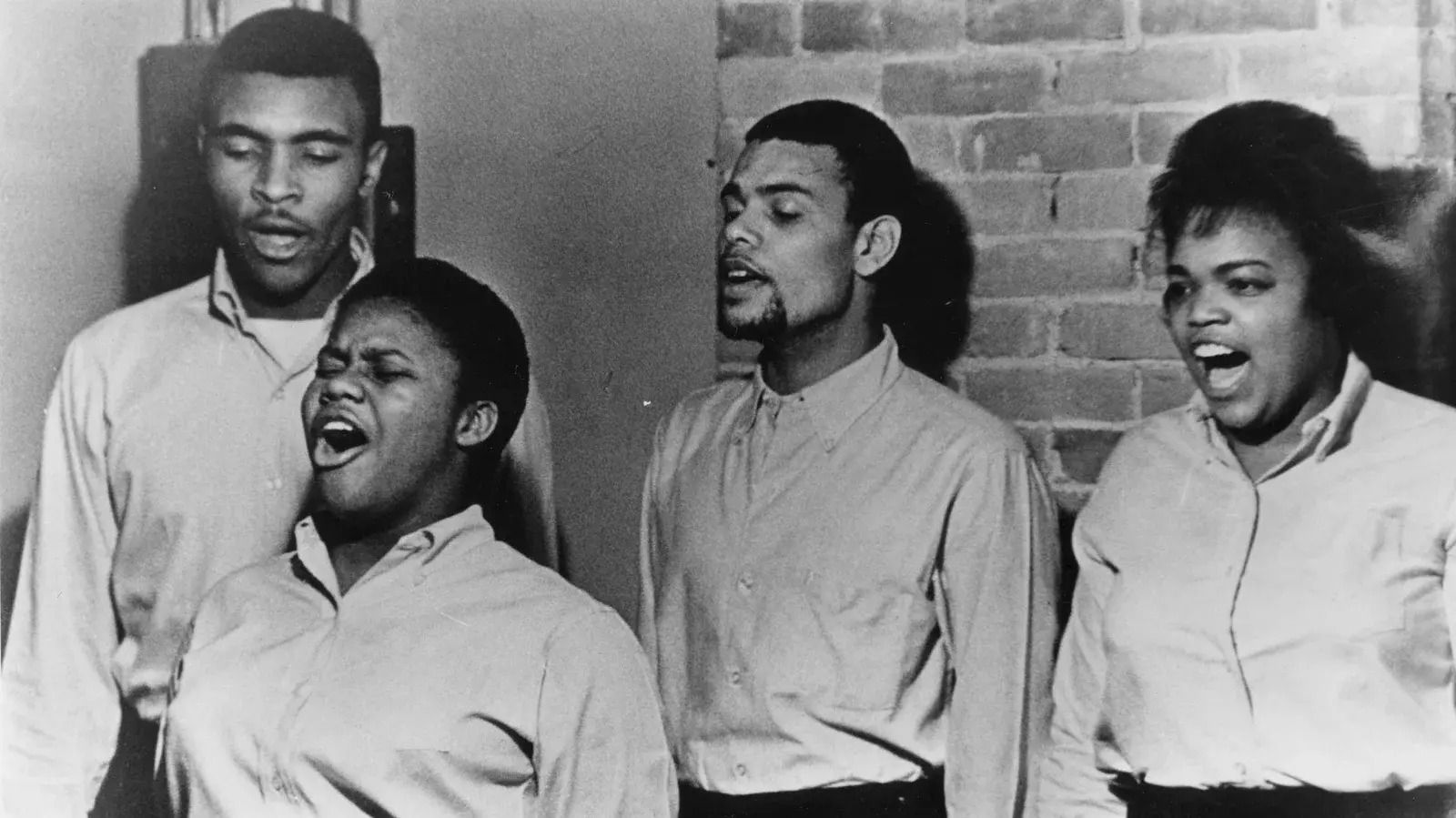
Photograph of The Freedom Singers, a quartet that blended gospel with protest songs and chants to propel the civil rights movement of the 1960s. Photo Source: NPR.
Listen to this playlist filled with songs like Stevie Wonder’s Happy Birthday that propelled the civil rights movement.
That’s all for today! Did you enjoy today’s issue? Here’s how you can support this work:
Make a one-time or monthly donation on our website, PayPal or Venmo (@reimaginednews)
Sponsor an upcoming issue
Refer this newsletter to a friend
Until next time,

Reply