- Reimagined
- Posts
- Take action against ICE: A comprehensive guide.
Take action against ICE: A comprehensive guide.
Tools to mobilize your neighbors, monitor ICE movement, protest IRL or online and create a safety plan along with the latest news.

Nicole Cardoza
January 25, 2026

Forwarded this newsletter? Subscribe here.
We’re just a couple weeks into 2026, and I’ve been stopped three times to prove my citizenship at three different airports, each under the guise of a routine screening that feels like anything but. My last name, Cardoza, is Portuguese. It comes from my dad’s side of the family, who are from Cape Verde, a small country off the coast of Western Africa that the Portuguese colonized to create a convenient pit stop for the burgeoning transatlantic slave trade. After the slave trade ended, hundreds of thousands of Cape Verdeans – who often reflect a racial blend of West Africans and Portuguese settlers – legally immigrated to New England to work in the whaling business. My great-grandfather, who carried my last name, arrived here in 1908. He was 11 years old. His naturalization records list him as sex: M, color: white, nationality: Portuguese.
But each time I’m stopped I’m asked if I speak Spanish, or what par of South America my family is from. While I was pulled over by CBP in 2022 leaving Big Bend National Park and had my car searched (because, according to them, “no one just goes to a park by themselves” to sightsee), one agent insisted on speaking to me only in Spanish despite my insistence that it’s not my language. “You don’t speak Spanish?” an agent with the last name Espinoza sneered at me last week, as if it was another reason to question my validity.
The government doesn’t care about our lineage. They’re not concerned with the meaning of our last names, our immigration status, or our racial and ethnic identity. They do not care if we’re peacefully protesting or calmly documenting the injustices unfolding around us. They do not care if we are five years old, if we are mothers or fathers, or if we’d die in detention. They’ve targeted Native people who were here before America existed. They are committed to using this gross abuse of power to reinforce an illusion of danger, to make us more afraid of each other than them, to turn us against one another to create a country easier to control.
We need each other now more than ever. We’ve got to see the stories they choose to ignore, the stories where our humanities are rooted. Today’s newsletter, like many I’ve sent before, is full of resources as an invitation to togetherness, a call to community. You are my neighbor. You aren’t alone. And together, as we have for centuries, we will keep each other safe.
Readers like you make this newsletter possible.Consider making a one-time or monthly donation on our website, PayPal or Venmo (@reimaginednews) to help sustain this work. You can always manage your subscription here.
Take care,
Nicole
ps – looking for the audio version of this newsletter? Click to read the web version, and you’ll find the audio recording at the top of the page. This is a service provided by Beehiiv, our email publishing platform, and AI-generated.

Follow the reports on ICE presence in your neighborhood (and add your own).
iceout.org is a community-driven tracker of ICE activity across the country. You can sign up for alerts in your neighborhood, along with anywhere your community may be located. You can also report what you see. This is urgent for keeping people safe now, but it also will act as helpful documentation as the violence of ICE unfolds.
The “SALUTE” acronym is a handy way to remember what to note in your reports:
Size: How many agents or officers do you see?
Activity: What are they doing? Has anyone been detained?
Location: Where exactly did you see them and what direction are they heading in?
Units: What types of officers are they or what words and markings can you see on their uniforms?
Time: What time was the sighting? Make reports as quickly as possible.
Equipment: What do the agents have with them, such as types of weapons, vehicles, crowd control methods, and other details?
I don’t see this shared often but it’s an important step: Also share any information you witness with your local vulnerable community directly. Set up a group text with neighbors in need of protection to let them know what’s happening.
Learn how to record law enforcement.
You have the right to observe and record law enforcement interacting with your community, and it’s incredibly powerful. Without user-generated content for the deaths of Renee Nicole Good and Alex Pretti, many more would believe the false narratives the government has circulated. As you do, here are tips to keep yourself safe.
This short video from independent LA-based media organization L.A. Taco gives you a handy checklist to keep yourself safe.
This video from Witness Media Lab shares how you can use videos to protect those featured in it.
Donate or volunteer for local community-based organizations providing immediate support to those most vulnerable.
These differ city by city. You can look at what your local churches, food pantries, and community-based organizations have posted lately, or search for the equivalent of the organizations listed below where you live.
National Resources
Here is a community-curated list of local, public-facing organizations that focus on immigrant support and advocacy.
Here’s a list of mutual aid organizations across the U.S.
Orgs to support in Minneapolis:
Orgs to support in Maine (where ICE is starting operations):
Orgs to support in Chicago:
Sin Titulo’s grocery runs (You can also sign up to volunteer)
Orgs to support in Los Angeles:
Contact your members of Congress.
Right now, Congress is working to approve a broad swath of funding measures ahead of the January 30th deadline to avert a partial shutdown. In there is legislation to fund the Department of Homeland Security, which will be used in part to fund ICE. The measure passed the House with a 220-207 vote, which included just seven Democrats. But now, with the death of Alex Pretti, Democrats are vowing to vote against the bill in the Senate, which could hinder the entire funding measure. Amnesty International is providing a good script that you can use.
You can also help locally in Minneapolis:
Contact the office of Tim Walz and call for an eviction moratorium for the next seven days, minimizing increased exposure to ICE for vulnerable residences.
Create a safety plan.
I write about this when confronting any crisis: having a safety plan right now is critical, especially if you know you’re likely to be a target – perhaps by your last name, your citizenship status, your visual features and how they may be perceived, or the neighborhood you live in. Anyone can be a target at anytime, so please don’t let this lead you to a fallacy of safety. Here’s what mine includes:
A list of where to go and what I’ll do if I find myself a target of ICE.
This website, which can be used to locate someone being detained by ICE for immigration violation or deportation.
Tools for how your community can find me if I go missing. You can share your location with your friends through your phone, use a Air Tag or other tracking devices, or share access to other tech that might be able to discern your latest whereabouts like a doorbell or camera (although these also expose you to surveillance risks).
The location of all my identification documents I have in my possession, including what I carry with me and what’s at home. If you don’t have all your documents, this is a good time to request copies:
Steps for my community to care for my dog if I disappear. For you this may include your children, pets or other dependents. Be sure this safety plan is shared with your dependents so they, too, know what to expect.
Memorized numbers of trusted family and friends I can call in a crisis.
Protest.
Showing up matters. Digitally, you can protest by amplifying stories from on-the-ground, sharing flyers and promotional assets, or volunteering with organizers behind-the-scenes.
You have a constitutional right to protest, but you are also exposing yourself to retaliation by state and federal law enforcement. Here are a few resources that can help:
Know your constitutional rights to protest
Best practices to keep yourself safe at a protest
Tips for protecting your identity in a world of surveillance
Best practices for keeping other protestors while filming at protests
Follow local, independent media.
We’re entering a more heightened state of misinformation, disinformation, and media suppression, especially now that TikTok has been bought by the U.S. government. Now, more than ever, it’s important that you know where to find accurate, non-partisan information for both affected cities and where you live.
I recommend signing up for newsletters or going to their webpages directly, instead of hoping the social media algorithm brings their content to your newsfeed.
Mobilize your neighbors.
Looking to build more coalition in your community? Want resources to help guide your collective response to ICE raids, or any crisis?
This Community Protectors toolkit, a comprehensive resource by COPAL, is a powerful way to start considering how to best approach the issues in your community.
Mapping Community Defense and Care in Our Neighborhoods is an incredible guide by organizer and activist Kelly Hayes with prompts you can answer with your community.
Create or join a neighborhood safety Signal group chat where you can chat on an encrypted platform about what’s happening and how to support.
 | Rupture and RepairTuesday, February 10 | 3-5pm EST Learn how to navigate moments of tension and conflict as they arise in professional settings. Participants will learn practical, real-time strategies for de-escalating situations, intervening effectively, and rebuilding trust after moments of rupture. We’ll develop a personalized toolkit for addressing workplace tensions while maintaining cultural awareness and psychological safety. |
 | Conflict Evolution 101Wednesday, March 11 | 3-5pm EST Learn how to navigate moments of tension and conflict as they arise in professional settings. Participants will learn practical, real-time strategies for de-escalating situations, intervening effectively, and rebuilding trust after moments of rupture. Through hands-on practice and scenario work, we’ll develop a personalized toolkit for addressing workplace tensions while maintaining cultural awareness and psychological safety. |

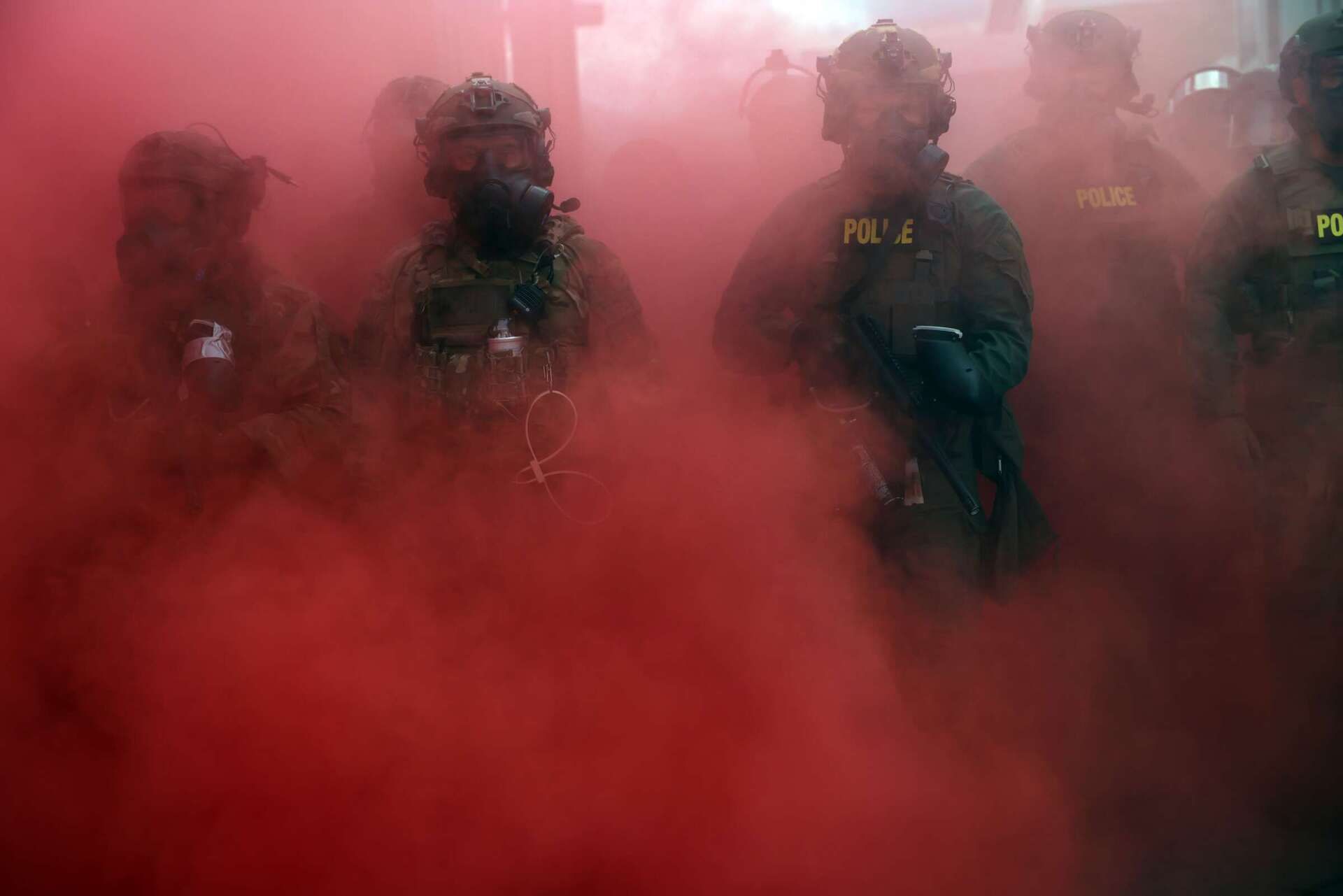
Federal agents, including members of the Department of Homeland Security and the Border Patrol, deploy a smoke grenade outside a downtown Immigration and Customs Enforcement facility in Portland, Oregon, on October 4, 2025.
SPOTLIGHT: ICE
Trump has made ICE the largest law enforcement agency in the country. With Congress-approved funding, ICE detention is expected to triple in size, mirroring the scale of Japanese internment. Truthout >
Alex Pretti shot and killed by Border Patrol agent in Minneapolis. The killing of Alex Jeffrey Pretti, an ICU nurse, is Minneapolis' city's second fatal shooting by a federal officer this month — and has set off another wave of outrage. NBC News >
“Everybody showed up”: Stunning crowds at Minnesota day of strike and shutdown against ICE. Extreme cold didn’t stop the shutdown on Friday as some 100 faith leaders were arrested, residents stayed home from work, and an estimated 50,000 or more marched through downtown Minneapolis. In These Times >
Half of American women support abolishing ICE. In Congress, progressive Democratic women are taking the lead in calling for dismantling the agency. 19th News >
'They are circling our schools,' superintendent says after 5-year-old detained by ICE. ICE operations in the Twin Cities are also affecting children who are caught up in the surge of personnel and detentions. PBS >
ICE shooting after takeover of Minneapolis renews debate on qualified immunity. After a deadly shooting in Minnesota, lawmakers are again questioning whether federal agents should be shielded from lawsuits. Capital B News >
‘There’s no customers’: Immigrant-run businesses struggle to survive as ICE terrorizes Minneapolis. Lake Street, a typically bustling thoroughfare lined with a diverse array of shops in southern Minneapolis, has turned into a ghost neighborhood. Prism >
After Haitians endured campaign lies, An Ohio town prepares for ICE. Falsely accused of eating pets, and worse, Haitians in Springfield have survived harassment, and now fear deportation. Marshall Project >
Maine protests continue as violence ramps up in Minneapolis. Read for live updates on ICE presence unfolding in Maine as Gov. Mills demanded President Trump withdraw federal immigration agents from Maine. Portland Press Herald >
POLITICS
A majority of Americans view Trump’s first year as a failure. Most surveys show Trump's net approval rating in the negatives — and by double digits. Truthout >
It just got harder for LGBTQ+ people to address harassment at work. The EEOC voted Thursday to delete a 200-page document on workplace harassment matters amid a push to prioritize cases brought by white men. 19th News >
CRIMINAL LEGAL SYSTEM
MLK’s struggle against policing and surveillance is still alive in Memphis today. From surveillance of racial justice organizing to terror under Trump’s Memphis task force, we face ongoing repression. Truthout >
REPRODUCTIVE RIGHTS
Women with high-risk pregnancies have limited options under abortion bans. Reporting from ProPublica found that abortion bans generally don’t include exceptions that cover health concerns pregnant women with chronic conditions can face — or if they do, doctors aren’t using them. Propublica >
Virginia voters will decide the future of abortion access. Virginians will determine whether to enshrine the protection of reproductive rights into the state constitution later this year. 19th News >
The high cost of child care is making mothers rethink having kids. Recent research suggests that the price of child care shapes fertility decisions like whether and when to have children, and how many to have. 19th News >
ENVIRONMENT
A major agreement to protect the Amazon is falling apart after 20 years. Amid changing political headwinds, the moratorium on soy-driven deforestation is in danger. What now? Grist >
Trump rollbacks put children’s health at risk as pollution increases. New federal decisions remove health protections as Black communities face rising pollution and asthma rates. Capital B News >
Documenting an Alaska village, before and after the storm that destroyed it. The story of Typhoon Halong’s destruction in Kipnuk adds an exclamation point to long-simmering fears about the future of Alaska coastal villages facing down climate change. ProPublica >
That’s all for today! Did you enjoy today’s issue? Here’s how you can support this work:
Make a one-time or monthly donation on our website, PayPal or Venmo (@reimaginednews)
Sponsor an upcoming issue
Refer this newsletter to a friend
Until next time,

Reply