- Reimagined (formerly Anti-Racism Daily)
- Posts
- What I learned in Gee's Bend.
What I learned in Gee's Bend.
On quilt making, grief, and threading together the experiences that shape us.

Nicole Cardoza
April 14, 2026

Forwarded this newsletter? Subscribe here.
Good morning and happy Tuesday! I’m settling home after spending the week in Alabama making quilts and exploring the state’s rich history. Today, I’m sharing more about my experience and reminiscing on the role of field trips in our lives.
Have you joined us on Patreon yet? Drop in to share your favorite grown-up field trip, explore job opportunities, and find recommended reading from our community. You can join for free, regardless of whether you’re a one-time or monthly donor, and every contribution is appreciated.
Readers like you make this newsletter possible. Consider making a one-time or monthly donation on our website, PayPal or Venmo (@reimaginednews) to help sustain this work. You can always manage your subscription here.
Hope you have a wonderful week,
Nicole
ps – looking for the audio version of this newsletter? Click to read the web version, and you’ll find the audio recording at the top of the page. This is a service provided by Beehiiv, our email publishing platform, and AI-generated.
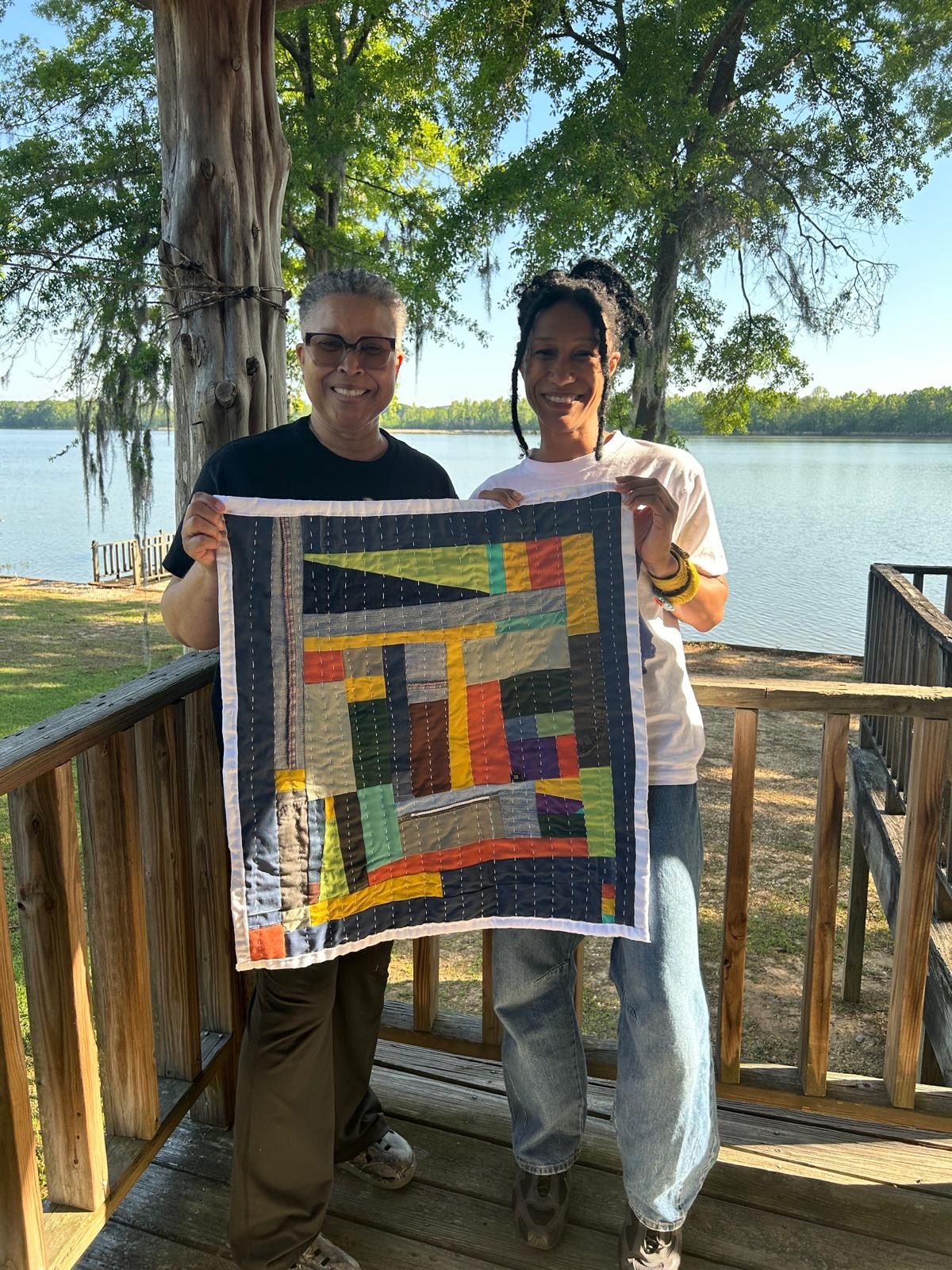
I spent four days learning traditional African American quilt making techniques with the quilt makers of Gee’s Bend. It was a wonderful experience, and I highly recommend it for anyone interested in learning about the collective’s deep roots, the quilt making process, or simply looking for a reason to learn (this not sponsored, to be clear. I just had such a wonderful time!) I booked this on VAWAA, which curates mini-apprenticeships with artisans around the world, and they were thoughtful and supportive on every step of the planning process. I’m looking forward to taking my next one.
Go quiltmaking in Gee’s Bend with Loretta and Marlene.
Explore mini-apprenticeships on VAWAA.
Learn more about the quilt makers of Gee’s Bend.
When I was a kid, I loved field trips. That's when the school would bring out the new buses — with dark blue seats that still smelled like fresh vinyl. We'd travel far, sometimes out of state, and eat a snack on the way. I spent most of my school days with a teacher's aide or in talented and gifted programming, so field trips were the few days when I could be just like everybody else. I travel constantly for work now, but I rarely schedule trips for myself. This year, I made a commitment to create space for curiosity and play. A former colleague is the founder of VAWAA, a platform that connects travelers with a curated set of mini-apprenticeships with artisans around the world. When I saw that a four-day quilt making workshop at Gee's Bend was on their site, I booked it before I even checked my calendar.
My mother was an avid sewer. On weekends, I'd spend hours with her in fabric stores, particularly one wholesale warehouse with rolls of fabric stacked against each other haphazardly, creating a forest so vast I'd see how long I could get lost in it before she noticed I was missing. The walls prominently displayed quilts with precise symmetry and perfect geometric shapes. I found them hideous and boring, and wondered why someone would choose them over a printed comforter of their favorite movie, like the garish Aladdin one I had at home. If I were a braver writer, I'd write that I came here because sewing reminds me of my mom, and I loved following her around fabric stores, getting lost in the bolts of fabric so tall they created a forest of possibility. I’d write about how we struggled to find understanding and safety in each other, and an ocean grows between us with every phone call, but I still miss her and imagine doing a workshop like this with her one day.
Instead, I'll tell you that I've loved the quilts of Gee's Bend since I first saw them in 2018. Unlike the precision and rigor of the sewing I learned in the children's sewing classes at JoAnn's Fabrics, these quilts felt like jazz — improvisational, flowing, alive, with so much story to tell. Each quilt reflects a legacy of women, generation after generation, who have quilted the way their mothers did, a craft you can trace back to Dinah, a woman abducted from Western Africa and believed to have been brought to the states on the Clotilda, the last slave ship that arrived in Mobile, AL in 1860. These quilts feel alive because they are; an active practice of remembering, rich with history and meaning.
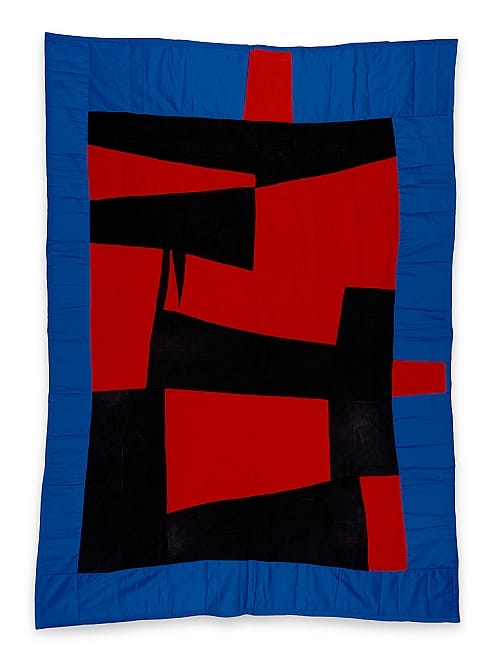
Medallion, by Loretta Pettway Bennett, 2005. Photo Source: Stephen Pitkin/Pitkin Studio

Do you plan field trips for yourself as an adult? What’s been the most nourishing way you’ve sparked your curiosity? Let us know on Patreon.
The quilts are made with mainly recycled materials, so, as instructed, I brought fabrics with me for mine. I chose scraps that reflected different parts of my life, like the first bandana my dog wore as a puppy. As Marlene and Loretta, my teachers for the week, helped me disassemble those pieces into building blocks, it felt like they were reassembling me, finding new ways for my pieces to fit together. I needed this because I've been feeling like I've been falling apart. I'm moving into a new career, which means I've had to say goodbye to projects and roles I no longer have space for. My friends are getting married, having children, and moving further away. My dog takes a bit more time to get up each morning. Gee's Bend is a community sequestered from the rest of the world by the Alabama River, which hugs its borders on three sides. The closest city, Camden, is only a 15-minute ferry ride away, but invisible from the banks of the river. When you stand on its edges and look out, there's nothing but the wild expanse of the water and the brush.
I was here, looking out at the horizon, when my dad called to tell me that my aunt, his sister, had died in a car crash. I didn't believe him at first. His mother's house had burned down only a few weeks before, and he had pulled her from the flames, wounding himself in the process. They are both healing, but my grandmother remains firmly disoriented. She still reminds my father to get the TV fixed. It used to be glitchy, but now it is gone — a lump of twisted metal in a house of ash and rubble, along with everything else she once held dear.
My father told me this from the parking lot outside her long-term care facility, agonizing over telling his mother her daughter is gone. I offered to call my youngest sister for him, to take one tough conversation off his plate. He declined. He knows that, like him and his sister, my sisters and I aren't close. "We're not the Brady Bunch," he lamented. I knew what he meant because we'd watched that show together as a family every week, and the opening sequence — where the eight family members smile and laugh with one another over nine neat squares — still plays in my mind at night when I can't sleep. My eyes stung with tears, blurring the line between the Alabama River and the deep blue sky, an empty expanse with nothing to cling to.
Marlene says that when you make a quilt, you're in conversation. With the fabric's texture, its weight, its color, and, most importantly, all the people it has encountered. When she lays out a quilt top, she speaks about the pieces coming together like a family — checking whether the colors, textures, and patterns agree with one another, making sure each piece feels at home within the full composition. "These two aren't talking," she declared decisively when two scraps of denim clashed side by side. "But these are familiar," she said as we replaced one with a silky, goldenrod swatch cut from the pants of the kurta set I wore to a friend's wedding in India. "I feel like I've been there now," she said as she caressed the fabric, and I could see her there with me, sticky with sweat in the warm evening as we danced down the streets, cars and people and horses and cows becoming one, collectively bearing witness to a tender new love that was sparked in New York City, which felt like a universe away.
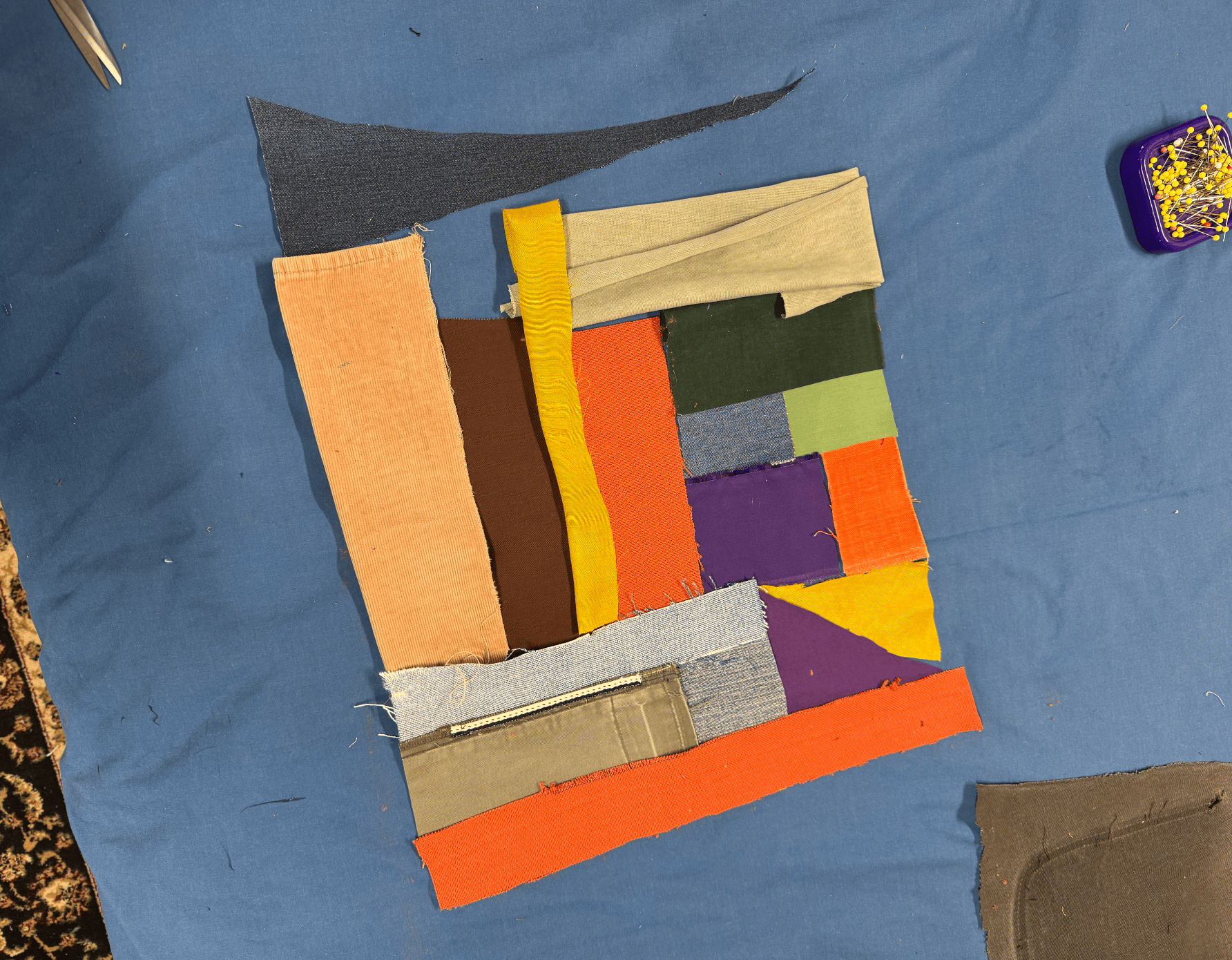
The beginnings of my quilt, which includes the yellow from the kurta, other sentimental scraps of fabric, and fabric provided by the quilt makers. We took out the pinkish beige strip on the upper left-hand side because it “wasn’t talking” to the rest of the pieces, the color too fleshy compared to the rest of the composition.
When someone dies, you feel like the whole world is supposed to die with them. But there was still work to be done, so I walked back into the room and returned to my work. When I got back to the house that evening, the baby cows were still chasing each other around the field on wobbly, clumsy legs, and the sun seemed determined to set only to rise again. I thought about giving her a call to see how she was doing before remembering that wasn't a choice anymore.
When you look at a Gee's Bend quilt, you may be drawn to the collage of fabrics. It's easy to overlook the thread — the often invisible, unsung part of a quilt we take for granted. Some of the stitches are clearly visible; in the Gee's Bend way, each quilt is hand stitched by one or many women in the collective, and they often add to the conversation on the top. But underneath, there are thousands of stitches you'll never see, each making meaning of disparate parts, yoking stories and experiences into a narrative, a force that carries the rich history of each quilt from one generation to the next. The stitches are the quilt's veins, its heart and lungs, what keeps both the craft and its meaning alive, stitch after stitch, generation after generation.
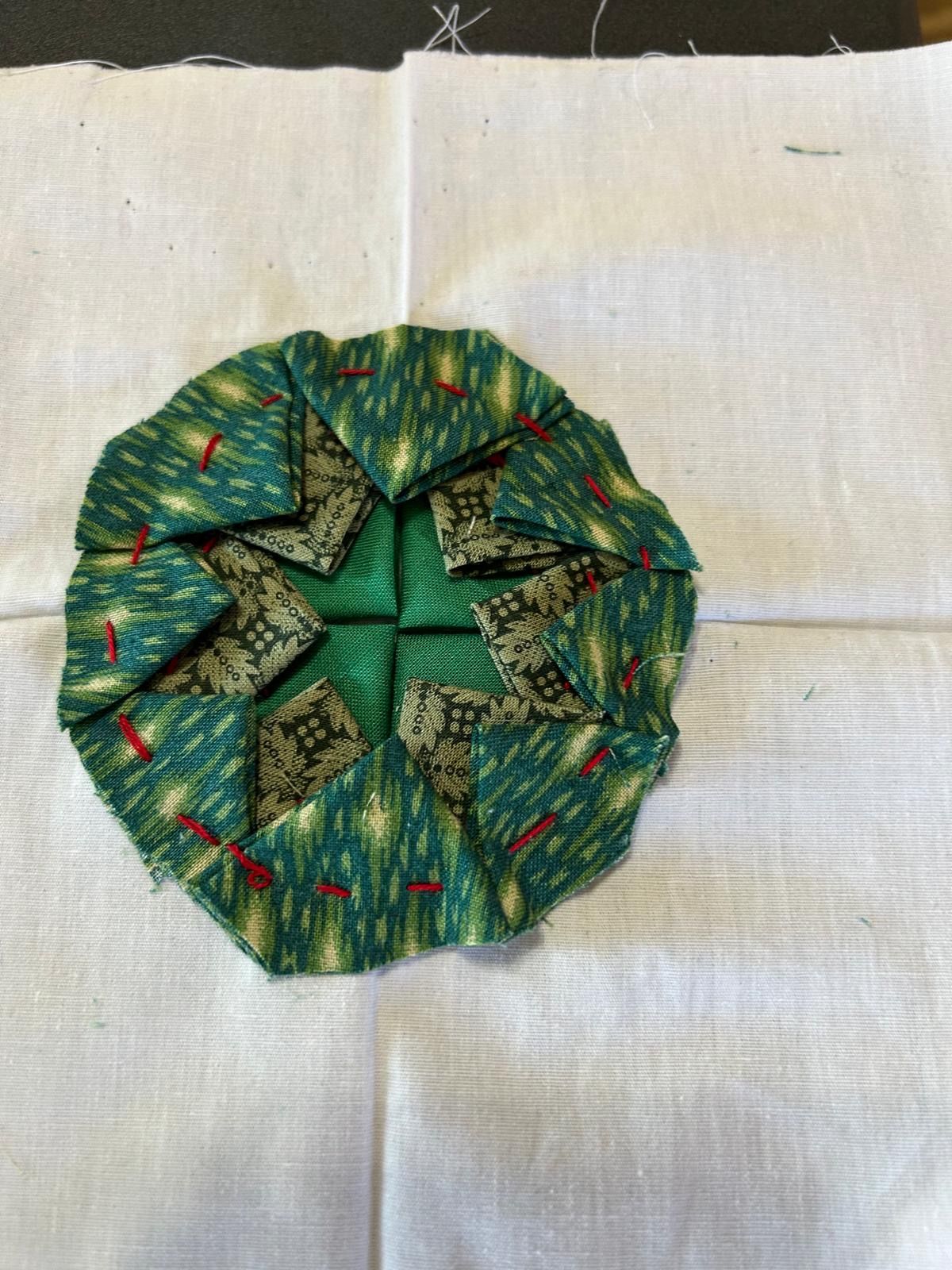
Sewing became harder with fresh grief. I could barely thread a needle, and struggled to hide my stitches in my first pine burr. I broke the thread twice while stitching my first yo yo, which forced me to start all over again each time. My hand stitches are notably more wobbly and clumsy than those of Loretta and Marlene. The thread would fight the fabric, or the needle would stubbornly poke through a different point than I wanted. I had to focus on the thread, not the frayed edges of the pieces or my feelings about them, before it could find its rhythm. Slowly, we started to find our path. Eventually, it seemed to sing as it traveled across the vast expanse of fabric.
My family is not close, but we are trying. My dad called me before he talked to his mother, and I picked up the phone. Tomorrow, I’ll call mine. I drove out of Gee's Bend with two completed quilts tucked into my suitcase, fingers sore from sewing, eager to go home to my spools and fabric scraps and make something new.
That’s all for today! Did you enjoy today’s issue? Here’s how you can support this work:
Make a one-time or monthly donation on our website, PayPal or Venmo (@reimaginednews)
Sponsor an upcoming issue
Refer this newsletter to a friend
Until next time,

Reply